


Behind every iconic celebrity home lies an untold architectural narrative that rarely makes it to magazine covers.
What fascinates me, after 15 years in architectural practice, is not the glamour — but the design intelligence, spatial psychology, and strategic vision that famous architects embed into these luxury residences.
Celebrity homes are not just high-end residential architecture.
They are deeply personal design statements, carefully shaped by some of the world’s most visionary architects. And today, we explore those untold stories.
Why Celebrities Choose Iconic Architects
When a celebrity commissions a home, they are not just buying square footage. They are investing in identity.
In my 15 years of practice, I have observed that luxury residential architecture at this level is less about opulence and more about authorship. Celebrities seek architects whose design language is unmistakable. They want a residence that reflects their persona, their philosophy, and often, their legacy.

This is why many of them turn to globally celebrated figures like John Lautner, Frank Lloyd Wright, or Zaha Hadid.
Not for fame.
But for architectural authorship. A celebrity home becomes a spatial autobiography. It must handle privacy, security, panoramic views, natural light orchestration, and high-end material articulation — all while maintaining a cinematic presence.
That balance is not accidental. It is deeply intentional. And this is where the untold design conversations begin.
Often, these architects are chosen not just for their portfolio, but for their ability to translate abstract aspirations into built form. The dialogue shifts from “How big?” to “What does this space represent?” That shift changes everything.
The Untold Story Behind John Lautner’s Celebrity Homes

When we speak about architect-designed celebrity homes in Los Angeles, one name consistently surfaces — John Lautner. But what often remains untold is the emotional and structural courage behind his designs.
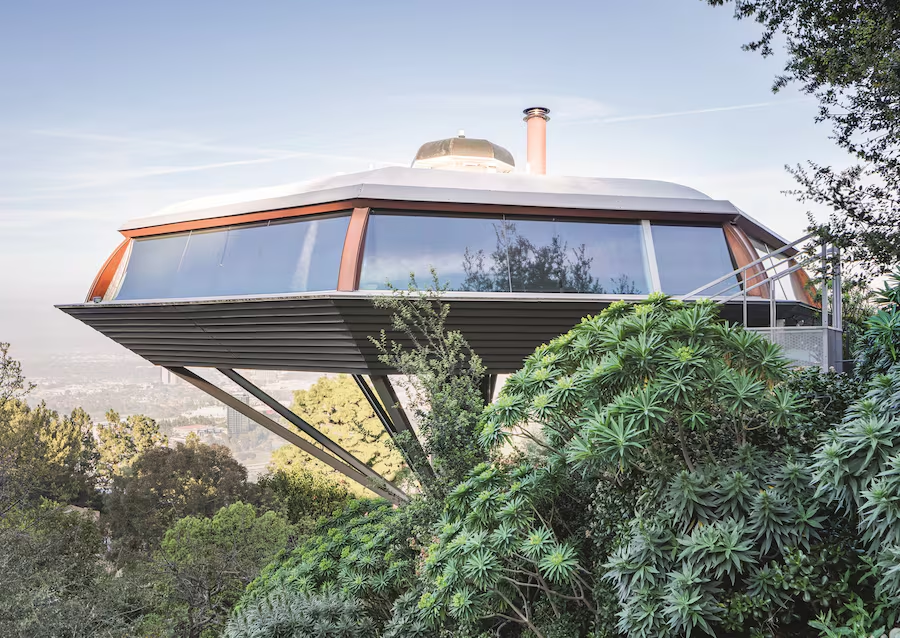
Take the legendary Chemosphere House. At first glance, it appears futuristic. Almost cinematic. But structurally, it was an engineering rebellion.
Perched on a steep Hollywood hillside, the home rests on a single concrete column. One. That decision was not aesthetic drama. It was a response to terrain constraints and zoning limitations — a masterclass in site-sensitive architecture. This is what fascinates me as a practicing architect.
Celebrity homes designed by Lautner were never about visual extravagance alone. They were spatial experiments — merging landscape, structure, and privacy into one seamless architectural language.
Another compelling example is the Sheats-Goldstein Residence. It wasn’t simply designed for luxury. It was designed for lifestyle choreography.

The open-plan living areas dissolve into the Los Angeles skyline. Glass planes disappear. Boundaries blur. The house becomes a viewing instrument — framing both the city and the owner’s persona.
This is high-end residential architecture operating at psychological depth. Lautner understood something profound: Celebrities do not just need privacy. They need controlled exposure.
That balance between visibility and concealment is one of the most underrated aspects of celebrity home architecture.
And this is the untold brilliance — the architectural strategy beneath the glamour.
Frank Lloyd Wright and the Culture of Private Patronage

Long before Hollywood glamour became synonymous with luxury residential architecture, Frank Lloyd Wright was quietly redefining what a private residence could represent.
What many do not realize is that Wright’s relationship with elite clients was never transactional. It was ideological.
He did not design “celebrity homes” in the modern PR sense. He designed architectural philosophies — tailored to powerful personalities.
Consider the iconic Hollyhock House, commissioned by oil heiress Aline Barnsdall. This was not merely a luxury residence. It was an experiment in spatial symbolism.

Wright embedded abstract hollyhock motifs into the façade, integrated indoor-outdoor living decades before it became a California cliché, and manipulated axial planning to create procession and pause.
As an architect, I find this particularly powerful. Because designing for influential clients requires more than technical excellence. It requires intellectual conviction. Wright often challenged his patrons. He pushed budgets. He defended design decisions. He resisted compromise.
And that tension created some of the most iconic residential architecture in history.
What’s the untold story here?
Celebrity or elite homes succeed when architects protect the integrity of the design vision — even under pressure. Luxury home design is not about indulgence. It is about authorship under scrutiny.
For more details on Frank Lloyd’s untold story read this bit – 6 Influential Architects and their Iconic Signature Styles
Zaha Hadid and Architectural Identity in Luxury Residences

When discussing bold, high-end residential architecture in the 21st century, the conversation inevitably leads to Zaha Hadid. What makes her work particularly compelling in the context of celebrity homes is not just form.
It is presence. Hadid’s residential projects were not designed to blend in.
They were designed to command. Take the Capital Hill Residence, a private luxury residence commissioned for a high-profile client in Russia.

At first glance, it appears almost extraterrestrial. Fluid geometries. Layered volumes. Elevated forms cutting through forested terrain.
But beneath that sculptural language lies meticulous spatial logic. The residence separates public entertainment zones from deeply private quarters through vertical zoning. Circulation flows are choreographed to maintain security and exclusivity — an essential consideration in celebrity home architecture.
This is something many overlook. Designing for influential clients today requires integrating:
- Security strategy
- Privacy gradients
- Controlled visual access
- Experiential arrival sequences
All without compromising aesthetic boldness. Hadid’s approach proves a powerful point: Luxury home design at this level is architectural branding. The home becomes a statement of ambition. And that is the untold layer — the strategic calibration between spectacle and control. As architects, we must understand that celebrity residences are not simply high-end houses. They are spatial identities.
For more details on Zara Hadid’s untold story read this bit – Biography & Works of Zaha Hadid: The Queen of Curves
The Psychological Architecture Behind Celebrity Homes
This is where the untold depth truly lies. Designing celebrity homes is not about marble finishes or infinity pools.
It is about psychological architecture. When an architect designs for a public figure, the home must negotiate two opposing forces — visibility and invisibility.
Celebrities live in exposure. Their homes must offer retreat. This creates a fascinating architectural challenge.
As designers, we begin to think in layers: Layer one — public reception zones. Layer two — semi-private entertainment spaces. Layer three — deeply personal sanctuaries.
This spatial zoning is not accidental. It is strategic. High-end residential architecture for celebrities often incorporates:
- Controlled sightlines
- Secured entry sequences
- Buffer landscapes
- Elevated plinths
- Internal courtyards

These are not aesthetic choices alone. They are protective devices. In projects like the Sheats-Goldstein Residence, the house frames outward views dramatically — yet shields inward life with precision. This balance between exposure and privacy defines luxury celebrity home architecture.
And here lies the untold lesson: True luxury is not excess. It is control.
Control over light.
Control over circulation.
Control over perception.
As architects and interior designers, we must understand this deeply. Because even if we are not designing for celebrities, we are always designing for human psychology.
What Architecture Students & Designers Can Learn From These Untold Stories
If you are an architecture student, interior designer, or architectural researcher reading this, I want you to look beyond the celebrity tag and focus on the architectural discipline behind these projects. The untold strength of famous architects who designed celebrity homes is not glamour, not budget, and not publicity — it is clarity of vision. When I analyze the work of architects like John Lautner or Zaha Hadid, what stands out is not just their iconic forms, but their conviction in spatial planning, structural logic, and material expression. Luxury residential architecture at this scale demands intellectual control. It demands that you understand site response, privacy gradients, circulation strategy, and the psychology of high-profile clients.

Celebrity home architecture simply magnifies what already exists in good design practice. Larger budgets do not replace good proportion. Visibility does not excuse poor spatial sequencing. High-end residential design still relies on fundamentals — light orchestration, climatic sensitivity, contextual integration, and human-scale detailing. The untold lesson here is powerful: you do not need to design for Hollywood to think like a globally respected architect. You need discipline. You need authorship. You need the confidence to defend your architectural language.
For designers in evolving markets like India, where luxury home design is rapidly transforming, this shift toward narrative-driven and psychologically intelligent residential architecture presents an extraordinary opportunity.
In the Indian context, few names demonstrate this scale of influence better than Hafeez Contractor: The Architect Who Built India’s Modern Skyline, whose work reshaped contemporary urban architecture and large-scale residential development.
Conclusion: Architecture Beyond Glamour
The untold stories of famous architects who designed celebrity homes reveal something deeper than exclusivity — they reveal responsibility. Behind every iconic luxury residence lies negotiation, conviction, and strategic design thinking.
Celebrity homes are not merely symbols of wealth; they are carefully orchestrated environments where privacy, identity, security, and architectural expression converge.
If you’re curious about how this unfolds in the Indian context, explore From Shah Rukh Khan’s Mannat to Ambani’s Antilia: India’s Most Iconic Celebrity Homes, where we examine luxury residential architecture within India’s cultural and urban fabric.
As architects and interior designers, we must recognize that true luxury in residential architecture is not excess — it is precision. It is the ability to control light, movement, scale, and perception with intention.
When we study these untold architectural narratives, we realize that the real takeaway is not about fame. It is about integrity. Whether designing a compact urban residence or a sprawling celebrity estate, the core remains the same — contextual sensitivity, structural honesty, and experiential richness. That is what defines iconic residential architecture. And that is what will continue to shape the future of luxury home design.


