


Howrah Bridge In Kolkata
Howrah Bridge Kolkata is not only a steel bridge across the Hooghly River; it is one of the strongest symbols of the City of Joy. For travellers arriving at Howrah Junction, office-goers crossing the river every morning, and photographers waiting for the perfect frame, Howrah Bridge represents Kolkata’s rhythm, history, and everyday energy.
Officially known as Rabindra Setu, the bridge connects Howrah and Kolkata without using pillars in the middle of the river. Opened in 1943, it continues to carry heavy traffic and thousands of pedestrians every day. Its scale, strength, and cultural presence make it one of India’s most recognised engineering landmarks.
What Is Howrah Bridge Kolkata?

New Howrah Bridge renamed as Rabindra Setu in 1965
Howrah Bridge is a suspension-type balanced cantilever bridge over the Hooghly River in West Bengal. It links the western bank at Howrah with the eastern bank at Kolkata, making it one of the most important transport connections in the region. The bridge is used by buses, taxis, private vehicles, cyclists, and pedestrians, but it is also a landmark that people associate instantly with Kolkata.
The bridge was renamed Rabindra Setu in 1965 to honour Rabindranath Tagore. Still, the older name remained in public memory, and most people continue to use it in everyday speech. This is why Howrah Bridge Kolkata remains a popular phrase in travel, history, and architecture discussions.
Quick Facts About Howrah Bridge
| Feature | Details |
|---|---|
| Popular Name | Howrah Bridge |
| Official Name | Rabindra Setu |
| Location | Over the Hooghly River, connecting Howrah and Kolkata |
| Type | Balanced cantilever bridge |
| Total Length | 705 metres / 2,313 feet |
| Width | 21.6 metres / 71 feet |
| Longest Span | 457.2 metres / 1,500 feet |
| Construction Period | 1936–1942 |
| Opened | 3 February 1943 |
| Official Name Since 1965 | Rabindra Setu |
History of Howrah Bridge
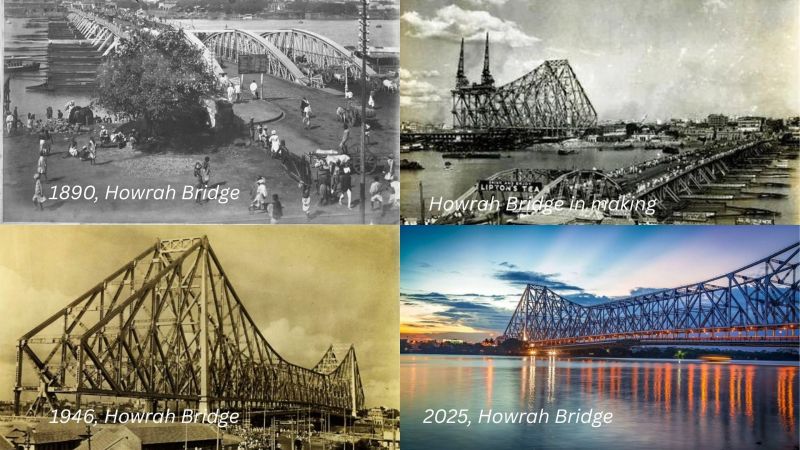
Phases of Bridge Design and Construction Process
The story begins before the present steel structure. In 1874, a pontoon bridge was built to connect Howrah and Calcutta. This floating bridge served the growing port city for decades, but as traffic increased, it became clear that a stronger and more permanent structure was needed.
Calcutta, now Kolkata, was an important commercial centre during British rule. The Hooghly River carried ships, ferries, and cargo, so the new crossing had to allow river traffic to pass freely. The present Howrah Bridge was constructed between 1936 and 1942 and opened to the public on 3 February 1943. Because it was completed during World War II, there was no grand opening ceremony.
Who Designed and Built the Bridge?
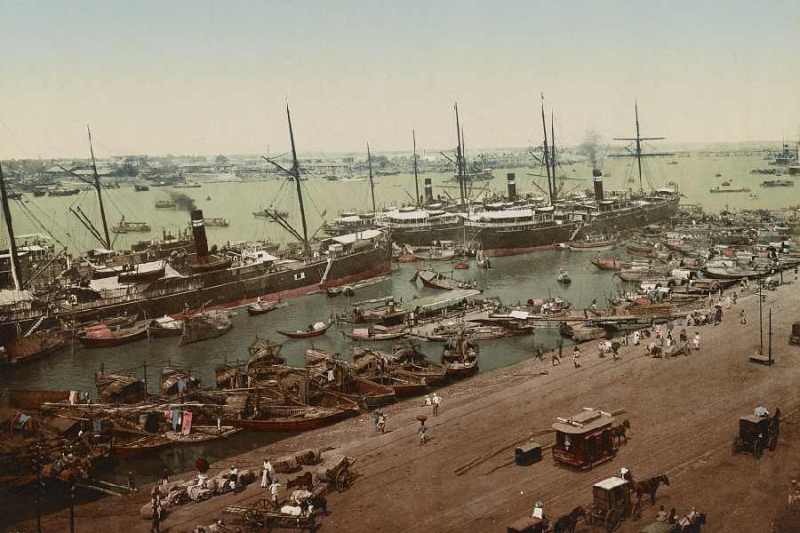
Old Calcutta Port
The new Howrah Bridge was designed by the British engineering firm Rendel, Palmer & Tritton. Construction was carried out by Braithwaite, Burn & Jessop Construction Company, a major engineering firm based in Kolkata. The project was closely connected with the Calcutta Port authorities because it had to serve both road traffic and river movement.
Unlike many bridges, the structure has no piers in the river under its main span. This was a practical decision. Ships and boats needed a clear path through the Hooghly, and the cantilever design allowed the bridge to stretch across the river without blocking navigation.
Engineering Features of Howrah Bridge Kolkata
The engineering of Howrah Bridge Kolkata is remarkable because it combines strength with simplicity. The main structure was assembled with rivets instead of nuts and bolts, a fact that still surprises many visitors. The steel framework carries huge loads every day, yet the bridge continues to stand as a reliable part of Kolkata’s transport system.
At the time of its completion, the bridge was among the world’s major cantilever bridges. Its balanced form shows how engineering can become architecture. It does not need heavy decoration; its beauty comes from steel members, repeated patterns, and the confidence of its structure.
Length and Width of Howrah Bridge
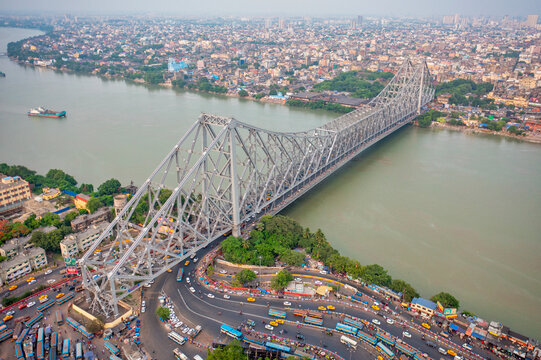
View of the bridge from above
The total length of Howrah Bridge is about 705 metres, or 2,313 feet. Its width is around 21.6 metres, or 71 feet, and the longest span measures about 457.2 metres. These dimensions made the bridge an outstanding achievement for its time.
The bridge has road lanes for vehicles and wide footpaths for pedestrians. Even after more than 80 years, the structure remains one of the busiest crossings in India. Also read: Chenab Bridge: World’s Tallest Railway Bridge.
Why Howrah Bridge Is Important to Kolkata
The importance of Howrah Bridge lies in both function and feeling. Functionally, it connects one of India’s busiest railway stations with central Kolkata. Emotionally, it connects generations of people who have crossed it for work, trade, travel, festivals, and family life.
For Kolkata, the bridge is like a public memory made of steel. It has appeared in films, postcards, paintings, travel videos, and countless photographs. A single view of Howrah Bridge Kolkata can immediately tell viewers where the story is set.
Lesser-Known Facts About the Bridge
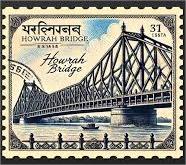
Postal stamp of the bridge
1. It Was Completed During World War II
The bridge was completed in 1942 and opened in 1943. Wartime conditions meant that the opening was quiet, but the structure soon became essential to daily movement.
2. It Has No Pillars in the River
The main span was designed without river piers, allowing ships and ferries to move freely along the Hooghly River.
3. It Was Built with Rivets
The bridge’s main steel members were joined with rivets, not ordinary nuts and bolts. This construction method gave the structure strength and flexibility.
4. It Was Renamed Rabindra Setu
The official name honours Rabindranath Tagore, but the popular name remains deeply rooted in everyday speech.
Best Time to See Howrah Bridge Kolkata
The best time to see Howrah Bridge Kolkata is early morning or evening. In the morning, the bridge often appears through mist rising from the Hooghly. In the evening, its lights reflect on the river and create a dramatic view.
Visitors can view the bridge from the riverfront, nearby ghats, ferry routes, or the Mallick Ghat Flower Market. The flower market is especially popular because it combines colour, movement, and one of the best views of the landmark.
How to Reach Howrah Bridge
Howrah Bridge is easy to reach because it stands close to Howrah Junction. Visitors can reach the area by train, bus, taxi, ferry, or on foot from nearby riverfront points.
- Nearest railway station: Howrah Junction
- Nearest airport: Netaji Subhas Chandra Bose International Airport
- Nearby landmark: Mallick Ghat Flower Market
- Best viewpoint: Hooghly riverfront and ferry route
Final Thoughts
Howrah Bridge Kolkata stands at the meeting point of history, engineering, transport, and emotion. It connects two banks of a river, but it also connects people, markets, memories, and generations.
For some, it is a daily road to work. For others, it is a landmark to photograph. For students of history and architecture, Howrah Bridge is a lesson in how infrastructure can become identity. More than 80 years after opening, it remains one of the proudest symbols of Kolkata.
FAQs About Howrah Bridge Kolkata
What is Howrah Bridge Kolkata famous for?
It is famous for its cantilever design, steel structure, daily traffic, historic value, and strong connection with Kolkata’s identity.
What is the official name of the bridge?
The official name is Rabindra Setu, named in honour of Rabindranath Tagore.
When was the bridge built?
It was constructed between 1936 and 1942 and opened to the public on 3 February 1943.
What is the length of the bridge?
The total length is about 705 metres, or 2,313 feet.


